Hello again everyone, Mr. Rude is back with part 2 of "How music and sound affects the brain". I hope that you found the first part informative. If you didn't then maybe this isn't the blog for you. Anyway, part 2 of this post is a continuence of an article that I found by Ben Geenfield that continues to explain about the chemicals in the brain that are affected by sound and different music for that matter on a daily basis. If you found the first part educational, then this part will also hit home pretty well. I want to remind all the viewers of this blog that this blog is for persons with interests in all things audio. If there is at anytimt you don't understand somthing that I post please feel free ask questions. That's what the comments section is for. I will always be glad to answer your questions with as much detail as possible and if there is something that I don't know I'll be glad to do the research for you and get the correct answer to you as soon as I can. Thanks again to all that view and comment on my blog. I really appreciate it. Thanks Again! PEACE
-MR. RUDE-
Article Starts Here:
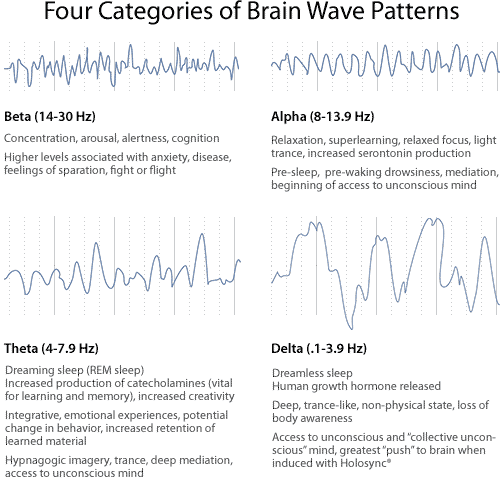
Most of us live the majority of our lives in a state of primarily beta brain waves – aroused, alert, concentrated, but also somewhat stressed.
When we lower the brain wave frequency to alpha, we can put ourselves in an ideal condition to learn new information, perform more elaborate tasks, learn languages, analyze complex situations and even be in what sports psychologists call “The Zone”, which is a state of improved focus and performance in athletic competitions or exercise. Part of this is because being the slightly decreased electrical activity in the brain can lead to significant increases in feel-good brain chemicals like endorphins, noroepinephrine and dopamine.
So, for example, when you meditate, you are focusing on something, whether it’s a candle flame or your breath going in or out, or a mantra or a prayer. When you focus like that, the electrical patterns in your brain slow down and relax, and the amplitude of your brain-waves generally stabilizes in the alpha wave range.
But it turns out that you don’t need to be a trained monk or meditate for weeks on end to be able to achieve this state of alpha brain wave relaxation.
Instead, you can use a concept called “brainwave entrainment” to get the same effect.
Brainwave entrainment is any method that causes your brainwave frequencies to fall into step with a specific frequency. It’s based on the concept that the human brain has a tendency to change its dominant EEG frequency towards the frequency of a dominant external stimulus (such as music, or sound).
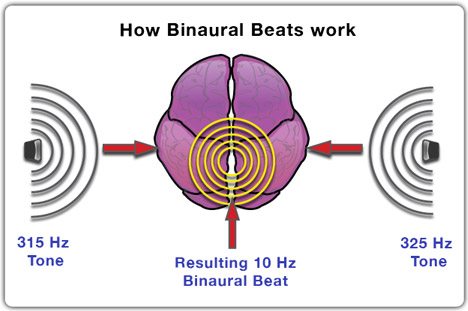
The type of sound frequencies that are typically used in brainwave entrainment are called “binaural” beats. The way that these work is that two tones close in frequency generate a beat frequency at the difference of the frequencies.
I know this sounds complicated, but it’s pretty simple to understand when you think about it. For example, a 495 Hz audio tone and 505 Hz audio tone (whether overlaid in music or in a sound frequency) will produce a 10 Hz beat, roughly in the middle of the alpha brain wave range, like this:
OK, so now we get to the cool, practical application of using sound and music to enhance your brain and change your brain wave frequences.
I hunted down an expert, Dr. Jeffrey Thompson, from
NeuroAcoustic.com, which produces and educates on using sound for stress reduction, relaxation, sleep enhancement, mega-learning, creativity, peak performance, meditation and higher states of consciousness.