Monday, November 25, 2013

W.L.R.C Founding


  Hello everyone, Mr. Rude is back with an incredible track. This post is the beginning of a new chapter in The Life and Times of Mr. Rude. For those who follow this Blog, Apologies for not posting in a while but I'm back to stay. Since the last time I posted I have graduated school with a Bachelors Degree in Audio Production, I have been to Texas and back, and (most exciting of all) I have opened the doors to my own recording facility around where my family and I are currently residing. Needless to say, its been a busy summer and fall. The name of our company is White Lion Recording Company, LLC. We took the name from combing the names of our two youngest children Bianca and Leo. Bianca meaning-WHITE, and Leo meaning- LION. I'm proud to say that I have my own place but I'll be even more proud when I begin to have clients on a regular basis. I will be posting every week with updates on the studio and different content that I may find interesting. Please continue to follow and comment on my posts. If you can, please like our face book White Lion Recording Company, LLC and stay tuned. Thanks!

                                                            -MR. RUDE-


Saturday, March 9, 2013


Hey everyone, Mr. Rude here. Due to the subject of my last post I thought it would be fitting to post a couple of songs (that most of us know)from Metallica that is a prime example of what too loud can do to your mix. The Album Death Magnetic is the bands latest album which was produced by Rick Rubin. If you compare this album to the Black album which was produced by Bob Rock you can clearly hear the difference between the 2. I have included songs from Death Magnetic and the Black album to let you be the judge of which sounds better. The beauty of audio is that it's subjective. Listen, make your choice, and send me some feedback about what you think. It would be intersting to find out what other people think, since we all hear things differently. Thanks again to everybody for you comments. PEACE!
                                                             -MR. RUDE-

The Loudness War


Hello everyone, welcome back to The Life and Times of Mr. Rude. To day I want talk about audio compression and what some in the audio industry are calling "The Loudness War". Today compression of an audio signal is now the norm for almost every track in a recording/mixing session.  The novice and beginner are under the assumption that their tracks must be as loud as possible but what they fail to realize is that louder does not always equal better. They do not understand that when you compress a track your messing with that single track (or the mixed 2 tracks) dynamic range. The dynamic range of an instrument is what gives the instrument its sonic and tonal characteristic. When you mess with that via compression/limiting you are essentially taking away the instrument is supposed to sound like naturally. As recording/mixing/mastering engineer it is out goal to capture the natural tone and sonic characteristic of any thing we record whether it be a guitar, bass, or vocal. Although compression is an essential tool for us it is imperative that we don't over do it. Don't fall into the trap of over compression it will just make your tracks sound amateur and to "Loud". I have included a short video that will let you hear what I'm talking about. Thanks again to everyone that views my blog and thanks to all those that post comments, I appreciate it! Until next time, PEACE.

                                   - MR. RUDE-

Friday, March 1, 2013

How music and sound affects the brain Part II


Hello again everyone, Mr. Rude is back with part 2 of "How music and sound affects the brain". I hope that you found the first part informative. If you didn't then maybe this isn't the blog for you. Anyway, part 2 of this post is a continuence of an article that I found by Ben Geenfield that continues to explain about the chemicals in the brain that are affected by sound and different music for that matter on a daily basis. If you found the first part educational, then this part will also hit home pretty well. I want to remind all the viewers of this blog that this blog is for persons with interests in all things audio. If there is at anytimt you don't understand somthing that I post please feel free ask questions. That's what the comments section is for. I will always be glad to answer your questions with as much detail as possible and if there is something that I don't know I'll be glad to do the research for you and get the correct answer to you as soon as I can. Thanks again to all that view and comment on my blog. I really appreciate it. Thanks Again! PEACE

                                                             -MR. RUDE-


Article Starts Here:

Most of us live the majority of our lives in a state of primarily beta brain waves – aroused, alert, concentrated, but also somewhat stressed.
When we lower the brain wave frequency to alpha, we can put ourselves in an ideal condition to learn new information, perform more elaborate tasks, learn languages, analyze complex situations and even be in what sports psychologists call “The Zone”, which is a state of improved focus and performance in athletic competitions or exercise. Part of this is because being the slightly decreased electrical activity in the brain can lead to significant increases in feel-good brain chemicals like endorphins, noroepinephrine and dopamine.
So, for example, when you meditate, you are focusing on something, whether it’s a candle flame or your breath going in or out, or a mantra or a prayer. When you focus like that, the electrical patterns in your brain slow down and relax, and the amplitude of your brain-waves generally stabilizes in the alpha wave range.
But it turns out that you don’t need to be a trained monk or meditate for weeks on end to be able to achieve this state of alpha brain wave relaxation.
Instead, you can use a concept called “brainwave entrainment” to get the same effect.
Brainwave entrainment is any method that causes your brainwave frequencies to fall into step with a specific frequency. It’s based on the concept that the human brain has a tendency to change its dominant EEG frequency towards the frequency of a dominant external stimulus (such as music, or sound).
The type of sound frequencies that are typically used in brainwave entrainment are called “binaural” beats. The way that these work is that two tones close in frequency generate a beat frequency at the difference of the frequencies.
I know this sounds complicated, but it’s pretty simple to understand when you think about it. For example, a 495 Hz audio tone and 505 Hz audio tone (whether overlaid in music or in a sound frequency) will produce a 10 Hz beat, roughly in the middle of the alpha brain wave range, like this:
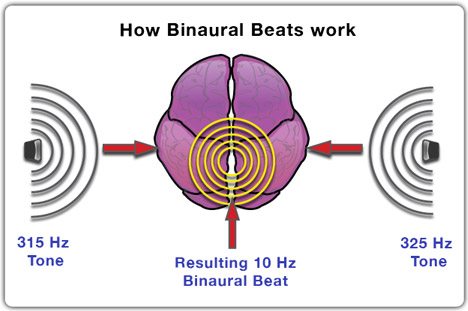
binaural beats

OK, so now we get to the cool, practical application of using sound and music to enhance your brain and change your brain wave frequences.
I hunted down an expert, Dr. Jeffrey Thompson, from NeuroAcoustic.com, which produces and educates on using sound for stress reduction, relaxation, sleep enhancement, mega-learning, creativity, peak performance, meditation and higher states of consciousness.

How music and sound affects the Brain Part I

Hello Everyone, Mr. Rude is back with some good information about how frequencies effect the brain and how they motivate us in different ways throughout our daily lives. In this two part post I'm posting an article by Ben Greenfield that expalins how important these elements are to our lives that no one really thinks about. Ben greefield is a fitness guy and I myself was pretty suprised about what this guy had to say. I hope you find this information useful and educational. Thanks again to everyone who views my blog and comments. PEACE!!

                                                                      -MR. RUDE-


Brain Waves

Most of us know that work out songs and music can help you to exercise harder
But if you understand how sound and music actually change your brain waves, you can use this knowledge to alter your mental and physical performance states with laser accuracy.
It sounds geeky, but I’m going to explain how…

At first glance, brain waves seem a bit like “woo-woo” science, and it can be a bit intimidating and confusing to understand how they work.
But here’s the basics, which will really help you when you’re listening to today’s interview with Dr. Jeffrey Thompson about how sound affects your brain.
Your brain is made up of billions of brain cells called neurons, and your neurons (just like the rest of your body) use electricity to communicate with each other. As you can probably imagine, these millions of neurons sending signals all at once produces an enormous amount of electrical activity in your brain, and this can actually be detected using medical equipment like an electroencephalography (EEG), which measuring electricity levels over areas of your scalp.
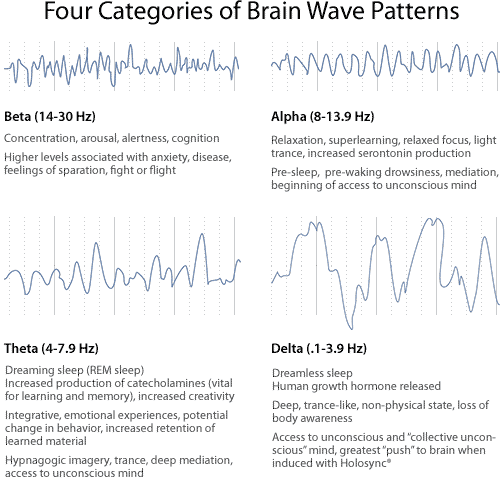
When you graph the electrical activity of your brain using EEG, you generate what is called a brainwave pattern, which is called a “wave” pattern because of its cyclic, wave-like nature.
And the brainwave patterns are generally categorized like this:

Brain Waves

Saturday, February 23, 2013

UAD LA-2A vs Waves CLA-2A.


Hey Everyone, Mr. Rude is back with an interesting blog post for those of you who know about the virtual LA-2A compressor plugins that are on the market today. I know that I may be jumping around as far as topics are concerned but I post what I feel at the time so please forgive me. Today some well known manufacturers of plugins such as Waves and UAD are diving into the past with some replications of some of the best old-school analog gear that has been used for decades. What I decided to do was post a video that compares two versions of the LA-2A Compressor from these manufacturers and let you decide which one is best or if there is any difference between the two. Although no virtual piece of gear will ever come close to being an exact copy of the real thing I beleive that the people behind these plugins are doing an awesome job with what there coming up with for the digital world. Again, I'll let you make up your mind to which sounds best and I hope you enjoy. Thanks to everyone for viewing my blog and I appreciate you comments. PEACE!!!!

                                                                       -MR. RUDE-

P.S. I own the Waves version and it is an awesome plugin with lots of power!!!!!

Saturday, February 16, 2013

Mr.Rude Video Blog


Hello everyone, Mr. Rude is back with another post for all those who have a love for audio. This week I'm taking a different approach by introducing a book that I have had the opportunity of reading and studying. The book is called "Understanding Audio" by Daniel M. Thompson. It is a book that has  very good and useful information for anyone who would like some in depth coverage about many aspects in the audio world. This book is a text book so it may be a little hard to read at first but if you go chapter by chapter it will all begin to make sense eventually. If there are any questions please feel free to post them on my blog and I will will be happy to answer them for you. Thanks again to all those who view my blog! I look forward to posting some new stuff in the future. Peace

                                          -Mr. Rude-

Friday, February 8, 2013

Episode 2 - Sound Behaviour Part 2


Hello everyone, Mr. Rude is back with some more knowledge that I think everyone who is interested in audio should know. A couple of weeks ago I posted Episode 1- Sound Behavior which discussed Sound Propagation and how different frequencies affect the way we hear things. In this episode the discussion focuses on Phase relationships and describes Constructive interference, destructive interference, and the 3:1 rule. This episode also talks about reflective surfaces and boundary behavior. In the reflective surface discussion the subjects that are focused upon are reflection, diffraction, transmission, and refraction. As you guys can see we are know beginning to get into some pretty technical stuff so if there are any questions about any of these terms please feel free to comment with questions. To all of you who already have knowledge about this stuff please feel free to just comment. This kind of information is really important to those of us who have a passion for audio and how sound works. I invite you to view this post and I hope you enjoy. Thanks to all of you who have been watching and commenting on my blog, I l look forward to posting new stuff in the future. THANKS AGAIN!!! PEACE

                                              -MR. RUDE-

Tuesday, January 29, 2013


Hello Everyone, Mr. Rude is back with another point of interest for those us who love sound and the way it works but first I would like to thank all of you who have viewed my blog and posted comments, I appreciate! Today, I would like to continue with some basics in audio that I feel are very important in understanding how sound travels in our environment. "Sound Propagation" is the term that is used to describe how sound travels through air and how it affects the air molecules around us. With out these air molecules the bass coming from the car passing by would never reach our ears because it's these molecules that carry the sound to us. In this video, sound propagation is explained in a way that may be elementary to some but completely alien others. You will hear words like like compression and rarefaction but don't worry about these terms right now. I'll explain those in a future post. Thanks again to those who view my blog and I hope that you get something out of this clip. Remember you can always comment and send me questions at any time. PEACE

                                                        -MR. RUDE-

Saturday, January 26, 2013

3D- Human Ear


Hey Everybody, this is my fourth post and I thought that I would switch it up a bit and get a little technical, informational, and educational for those who are just beginning to get into audio. To begin to understand the wonderful world of audio, I felt that it would be a good idea to post a short clip of how the ear deals with sound pressure which intern is turned into what "hear" on a daily basis. Now I know that this may be a bit elementary for those of us who already understand how sound works but again I think that this is good for those of you who are just starting out. I hope that you enjoy and I would appreciate some feed back. Thanks again for viewing my blog and I'll talk to you soon. PEACE!!!

                                         Mr. Rude           

Wednesday, January 23, 2013

Explaining The beginning influences of Mr. Rude


This interview was done at The Illinois Institute of Art-Chicago's loop campus audio suite. The basis of this interview was to explain the beginning of my musical love and interest. In the interview, I talk about when I first felt that "buzz" for performing and how it basically paved the way for where I am today and where I want to be in the future. I feel like this is a small window into my past that not to many know and I enjoy sharing it with those who share my same passion for everything music. I want to thank Regina Williams for asking such great questions. She opened up memories that I hadn't thought of or spoken about in years. I also want to thank all of you whom have shown an interest in this blog and I look forward to sharing more of myself with you in the future. Thanks again, PEACE! 

                                                             MR. RUDE

By the way the console in the background is Digidesign 24track Pro Control running Pro-Tools 10. The monitors are KRK- Rocket 8's.

Monday, January 14, 2013

Mr Mike featuring Rude - Hard Life, Hard Times

Introduction

Hello everyone, this is Mr. Rude. It's a beautiful day in the Chi-City. This blog is set up to discuss different aspects of the recording/mixing processes that are currently trending across the country and around the world. There are many different styles of the recording and mixing process from New York to L.A. to London. Many different techniques for recording and mixing are being used today especially with the advent of the D.A.W (Digital Audio Workstation). But in order to completely understand the actual processes of making a song sound good and professional, there are many things that need to be known. In this blog I will post a some tips that I have personally taken the time to learn and some articles from industry books and magazines that will help the beginning audiophile understand the inner workings of music. I will leave this blog open for any discussion that comes to mind to anyone that is interested in making music and getting it to sound the best and getting out to the world so that people can here it. Please feel free to comment at anytime or don't. Thanks to anyone that decides to jump into the conversation! PEACE

                                                           - MR. RUDE-